Eight Auto-Flatten & Document Capture Models Buyers Request First
Each card mirrors a live catalogue entry, presented in the order Cologne procurement teams audit them: capture format, sensor resolution, interface and warranty.
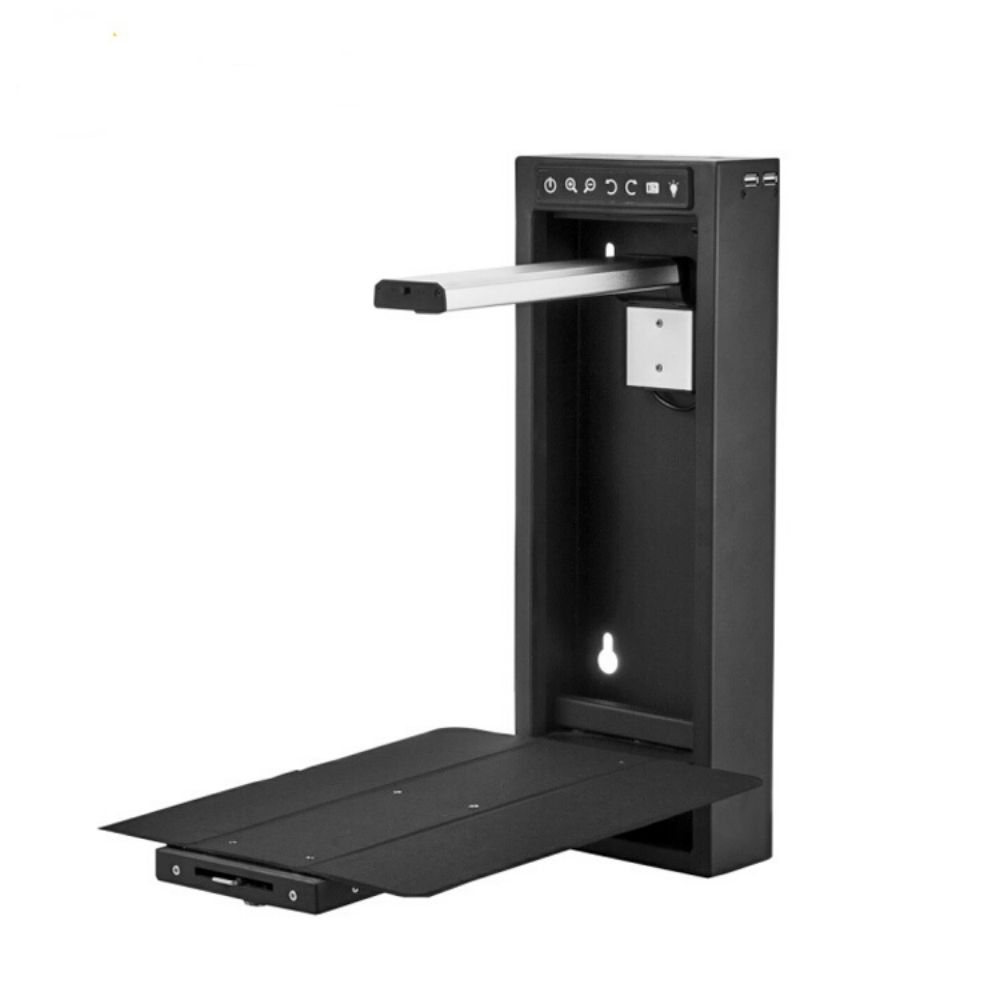
Online Training Portable 10MP A4 Document Scanner USB Visualizer
Wall version · Black + silver · 1-year warranty · In stock
View specification →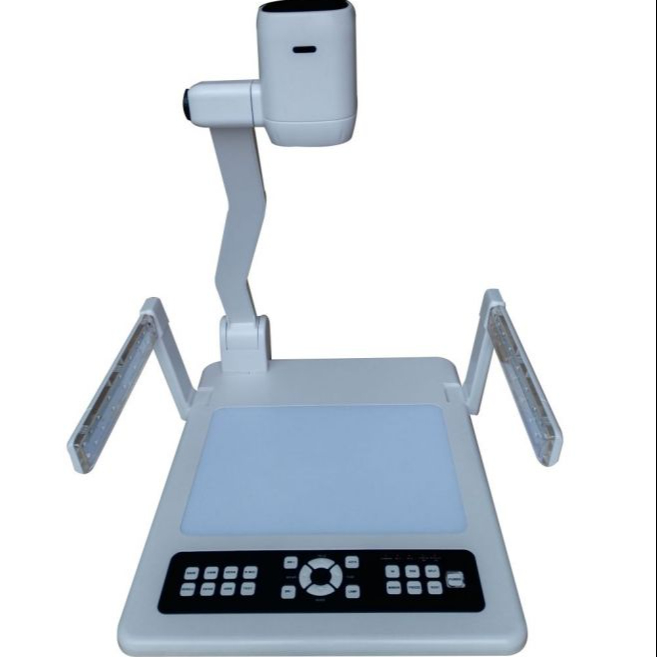
Factory Desktop Document Camera Visualizer 22X Optical Zoom
HDMI · RS232 · Audio, mic and video output
View specification →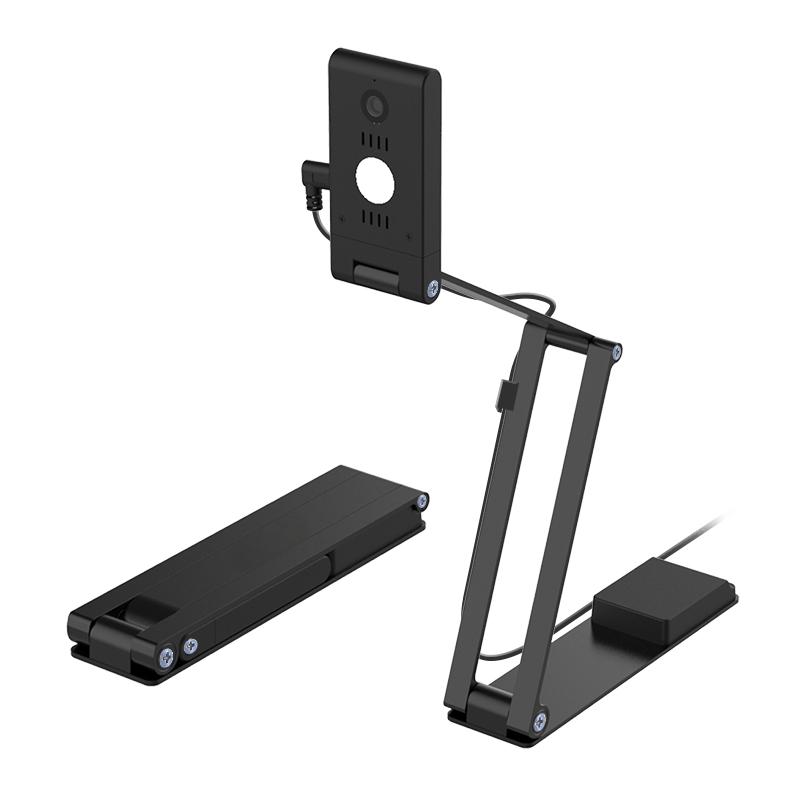
Value Priced 2-in-1 USB Digital Document Camera Visualizer A3
5MP 1/4" CMOS · 10x zoom · 1-year warranty
View specification →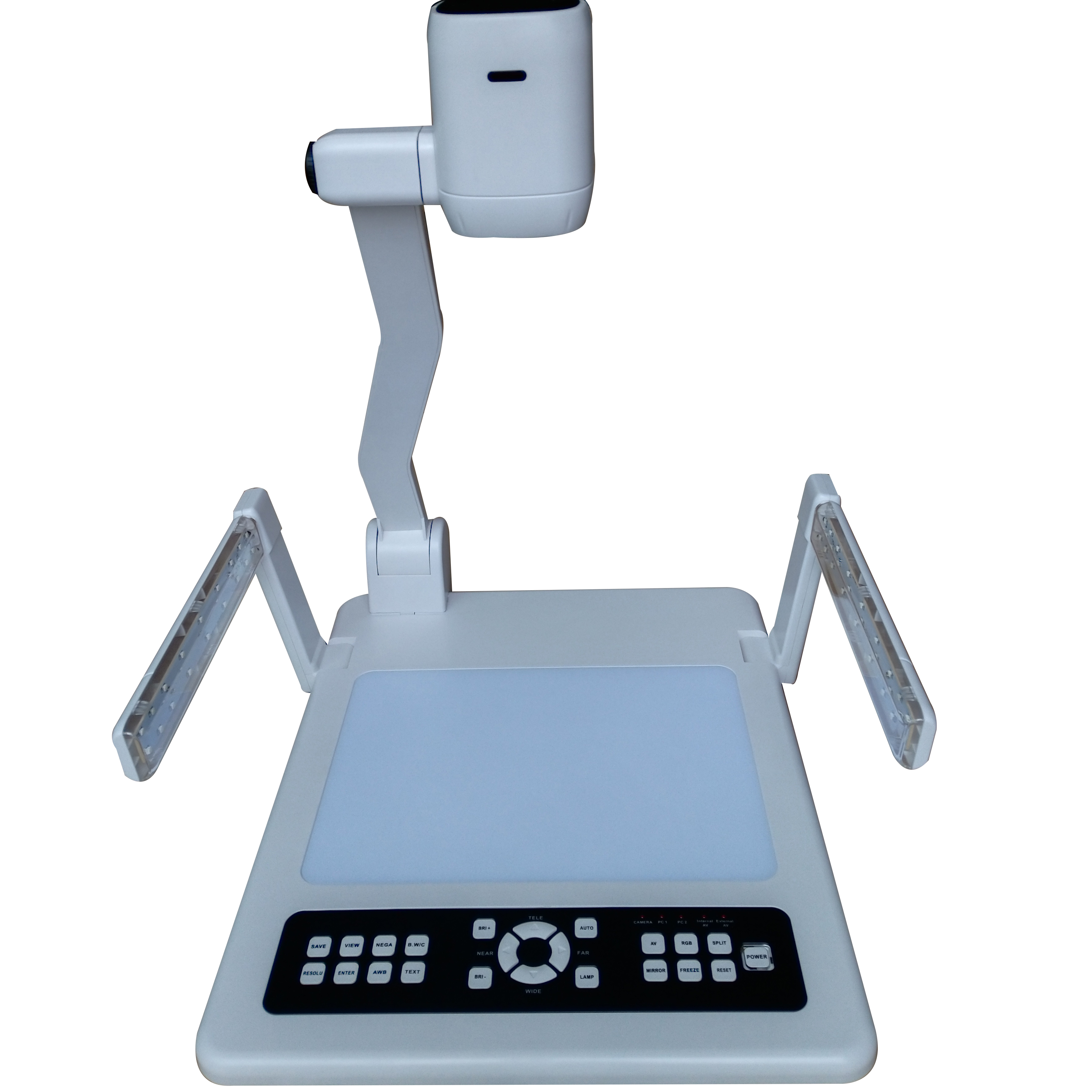
Modern Foldable Flexible Ultra HD Desktop Document Camera
HDMI / VGA output · School use · Visualizer mode
View specification →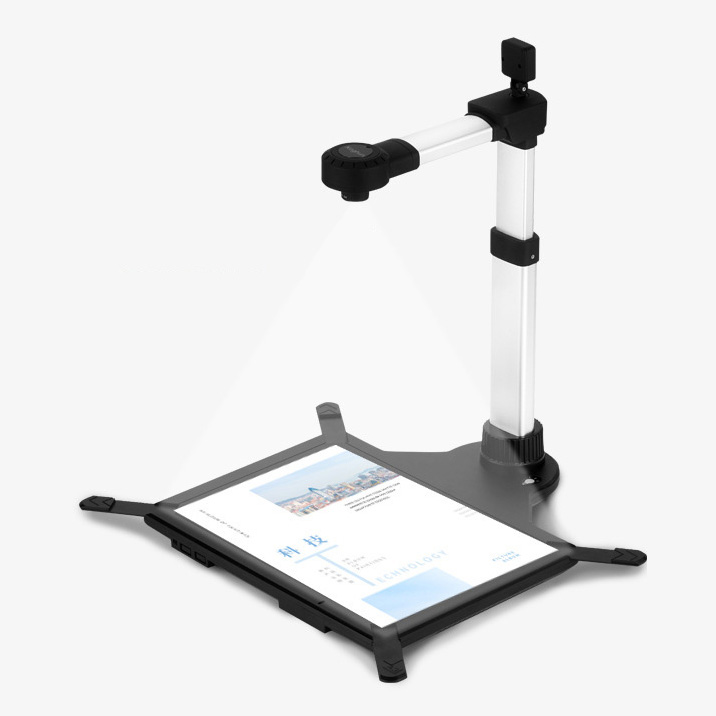
HD Dual Camera 16MP + 2MP Multifunction Document Scanner
60 pages/min · 360° rotation · 180° flip · USB smart capture
View specification →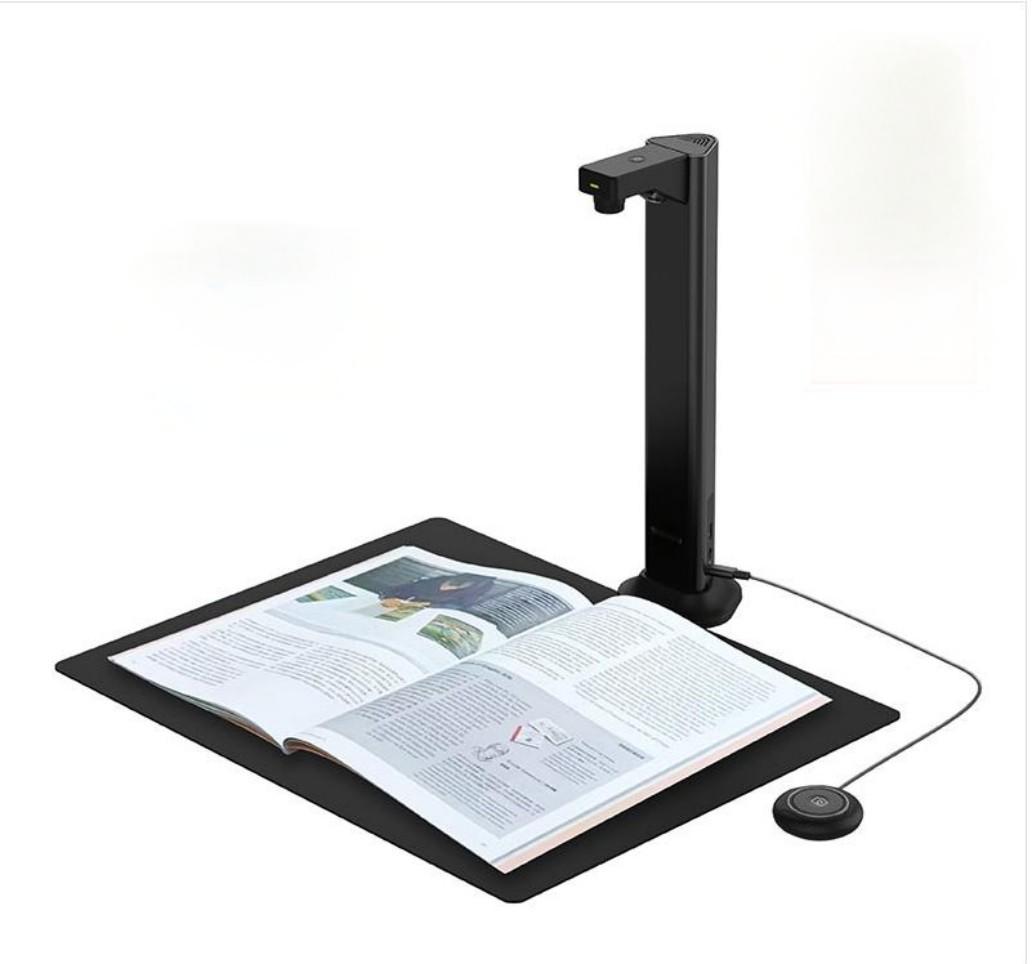
Real 24MP UVC A3 Document Scanner with Text to Speech
UVC driver-free · USB interface · In-stock product
View specification →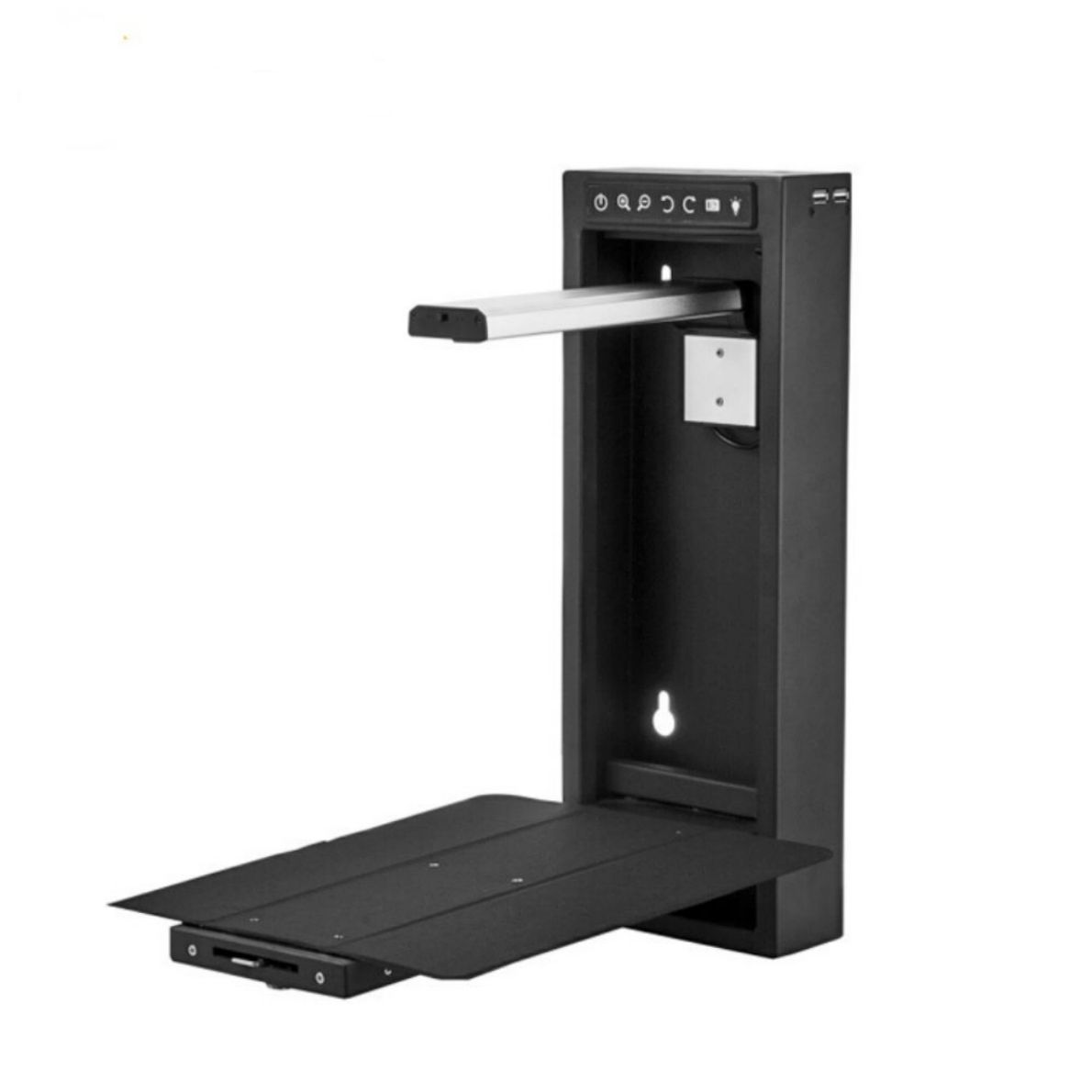
Factory New High Definition Wall Mount Document Scanner Visualizer
High-speed A4 · CE certified · 1-year warranty · SDK ready
View specification →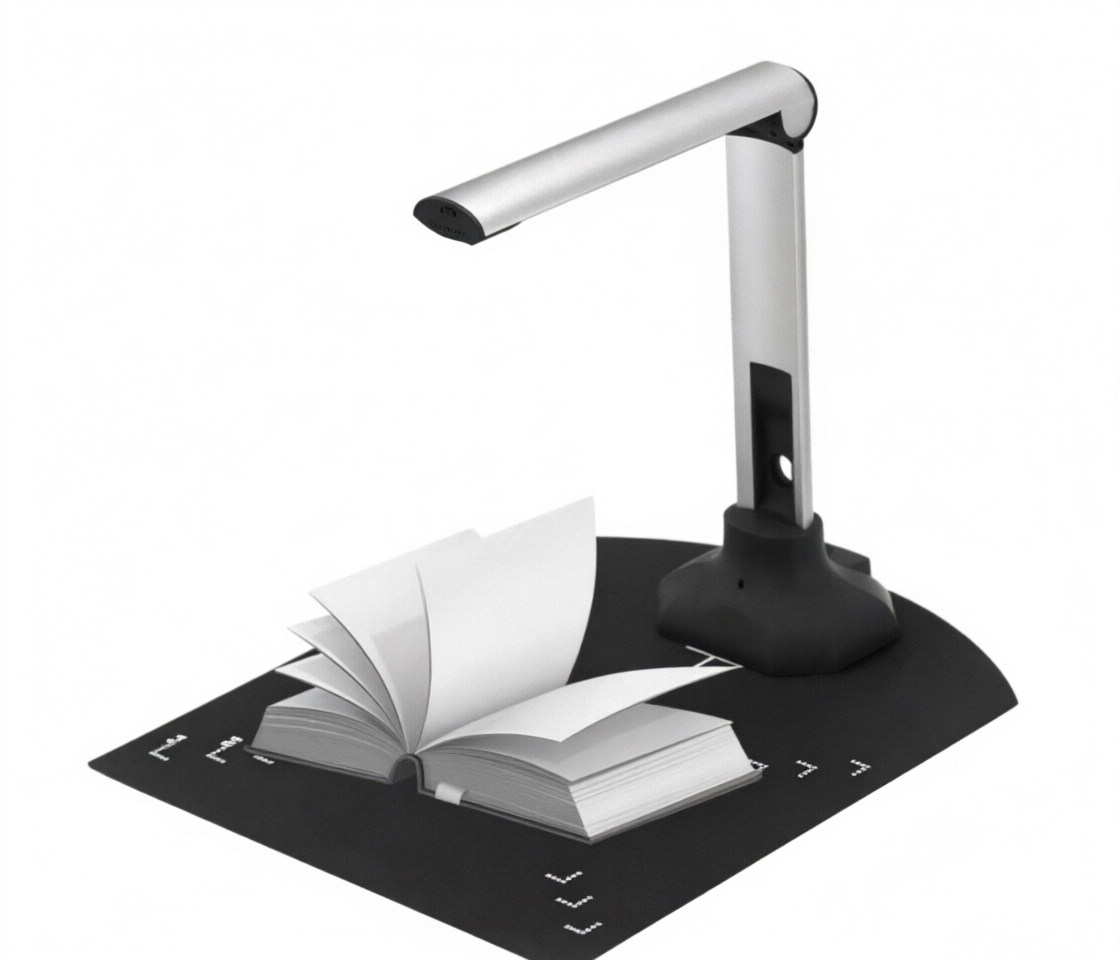
USB Document Camera Scanner 10MP CMOS Visualizer for Office & Education
Driver-free USB · A4 capture area · Office and classroom use
View specification →What Auto-Flatten and Deskew Actually Fix
A bound book is a three-dimensional object. Every scanner that ignores curvature is quietly selling you a webcam with a stand.
When a book lies open on a table, each page lifts away from the spine. A 400-page spring-back catalogue can rise 12–20 mm at the gutter; a tightly bound periodical volume can rise more. A CMOS camera mounted 350 mm above the platen does not see a flat sheet — it sees a curved surface, and the curvature compresses text widths near the spine by 20–35%.
Auto flatten (curvature flattening) is the first algorithm. The software detects the paper contour, estimates the depth profile of each pixel column, and reprojects those pixels onto a virtual plane. Deskew is the second. Text baselines that were rotated by the curvature are detected and rotated back per line, so characters sit on a horizontal axis rather than drifting upward towards the gutter. A third step — spine shadow suppression and finger removal — handles uneven illumination and the operator's thumbs.
The measurable effect matters for Cologne buyers because labour is expensive. In our internal sample set, a 24MP camera without flattening returned roughly 82–87% character accuracy on a curved page; with flattening plus deskew enabled, accuracy moved above 98%. The scan itself takes 1.5 seconds either way. What changes is the four to six minutes of manual correction, re-scanning and proof-reading that a research assistant otherwise spends on every page.
- Libraries get OCR that survives a 300-page journal volume without a page-level rework queue.
- Archives get faithful masters of fragile, acid-browned paper that must never be pressed flat.
- Notaries and law firms get a defensible, indexed digital copy that a court can read.
- Media and creative studios get searchable archives of scripts, storyboards and contracts.
If a supplier cannot send you a demonstrable 300 dpi auto-flatten PDF made from a real bound book — not a product brochure — they are selling a webcam on a stand, not a book scanner.
CIS, CMOS or CCD: What a Cologne Procurement Team Should Specify
All three imaging platforms are in active production. Choosing the wrong one is the most common reason a pilot project stalls after month three.
CMOS Area Sensor
Captures the whole page in a single exposure from above, so nothing touches the binding. This is the platform that makes auto-flatten and deskew possible. Typical range: 10MP to 48MP, USB or UVC output, Windows and macOS software with SDK access.
CIS Contact Sensor
A slim linear sensor reading the sheet at close range. Compact, low-power and fast on a sheet-fed path. The right answer for high-volume loose-leaf batches — invoices, contracts, HR files — at 60 ppm duplex and above.
CCD Linear Sensor
A moving optical carriage with greater depth of field and stable colour rendering. Tolerant of originals that sit slightly proud of the glass, which is why zero-margin bookedge flatbeds and photographic reproduction work still rely on it.
Where Auto-Flatten Book Scanners Run in Cologne and North Rhine-Westphalia
Cologne is not a generic market. Six environments drive most of the demand across the Rhine-Ruhr corridor.
University and Public Libraries
Bound journal volumes, dissertations and newspaper compilations. Tenders typically specify 300 dpi output, searchable PDF and PDF/A-2b for long-term retention — the A3 auto-flatten class fits this brief almost exactly.
Municipal and Historical Archives
Fragile paper, oversize formats and Rhenish local-history holdings. Non-contact overhead capture is the only acceptable method when a binding cannot be opened beyond 100 degrees; A2 models handle folio and map formats in one shot.
Notaries, Law Firms and Tax Advisors
Scan-to-file work tied to GDPR and GoBD retention rules. Sensitive client files usually need local storage rather than cloud sync, which makes USB-attached capture with offline software the safer recommendation.
Media, Publishing and Agencies
Cologne is one of Germany's strongest media clusters. Scripts, storyboards, broadcast contracts and production archives need OCR-indexed, searchable files so editors and rights teams can retrieve a clause in seconds.
Pharma, Chemical and Manufacturing QA
Batch records, SOPs and controlled documents. Validation-heavy environments ask for consistent output, traceable scan logs and PDF/A export rather than a consumer scanner with a detachable lid.
Schools and Vocational Training
Visual presenters with optical zoom show textbooks, experiments and physical parts live on a projector. Portable document cameras add a fast capture path for lesson material without a second device.
Local Trends Shaping How Cologne Buys Document Capture Hardware
Four shifts are visible across enquiries from North Rhine-Westphalia, and each one changes the specification sheet.
- Online-access legislation pressure. The drive to publish administrative and archival material digitally has pushed municipal and institutional buyers from "scan on demand" towards continuous bulk capture. That favours devices with a stable capture cadence and a documented workflow, not one-off flatbeds.
- PDF/A and GoBD compliance. Procurement questionnaires now routinely ask for PDF/A-2b export, deterministic file naming and an audit-friendly file path. A scanner that only outputs JPG is increasingly unprocurable, regardless of price.
- Data sovereignty and GDPR. "Where does the image go before it reaches our server?" is now a standard question. USB-attached capture running local software removes an entire category of data-processing agreement from the purchase, and it is often the fastest way to get a project signed off.
- Multilingual OCR. Cologne's population is diverse, and collections reflect it. Buyers increasingly test German OCR accuracy alongside Turkish, Polish, Russian and English recognition — a single-language engine is no longer enough for a public collection.
- Energy and total cost of ownership. LED illumination, low standby draw and long service intervals are moving up the scoring matrix, because a device that runs eight hours a day for six years is a facilities cost, not a one-off purchase.
- Direct factory sourcing. More mid-size buyers now negotiate with the manufacturing partner in China rather than a domestic reseller, using OEM/ODM terms to build a branded line. The saving is real, but only if the buyer audits properly.
Top 10 Criteria for Auditing Book Scanner Factories & Wholesalers in Cologne
Any shortlist of ten candidate suppliers collapses quickly against these ten criteria. Score each one out of five before you request a quotation.
Auto-flatten proven on a real book
Ask for a raw versus flattened pair from the same page of a genuinely curved volume. Brochure renders prove nothing.
Deskew plus spine-shadow suppression
Deskew without shadow handling leaves a dark band along the gutter that breaks OCR on the innermost 15 mm of every page.
Honest megapixel-to-dpi arithmetic
Divide the sensor's pixel count across the document size. A 21MP sensor covering A2 delivers roughly 225 dpi, not 300 dpi — regardless of what the listing says.
SDK, TWAIN, WIA or UVC support
If the device has to feed your document management system, confirm the integration path in writing, including the operating systems and Mac silicon compatibility.
German OCR and PDF/A output
Test a page of dense German prose with compound nouns. Recognition of long compounds is where generic OCR engines fail first.
CE, RoHS and data-flow documentation
CE conformity plus a RoHS declaration is the baseline for EU import. Ask explicitly whether any image data leaves the local network.
MOQ and mixed-container flexibility
A supplier who will ship one unit as a sample and mix models in one pallet is easier to pilot with than one demanding a full container of a single SKU.
Warranty, spares and RMA turnaround
One-year coverage is standard. What differentiates suppliers is how quickly a replacement sensor module or light bar reaches Cologne.
Landed cost to Cologne
Compare FOB and EXW alongside an all-in delivered figure. Scanner hardware typically classifies under HS 8471.60; import VAT and freight must be in the comparison or the cheapest quote is often the most expensive.
Response speed and reorder record
A supplier replying within an hour with a clear technical answer, and with a measurable reorder rate, is a lower-risk partner than one replying in three days with a price list.
How Many Megapixels Do You Actually Need?
Megapixels are meaningless in isolation. What matters is the pixel count divided across the paper size, which produces the effective scanning resolution.
210 × 297 mm needs roughly 2480 × 3508 pixels. A 10MP camera is sufficient for office and classroom capture.
297 × 420 mm needs about 3508 × 4961 pixels. Specify 18MP to 24MP for a comfortable archival master.
420 × 594 mm needs about 4961 × 7016 pixels. A 48MP dual-sensor configuration is the safe choice for newspapers and maps.
Line-art, photographic reproduction and heritage objects still call for a flatbed with 48-bit colour depth rather than an overhead camera.



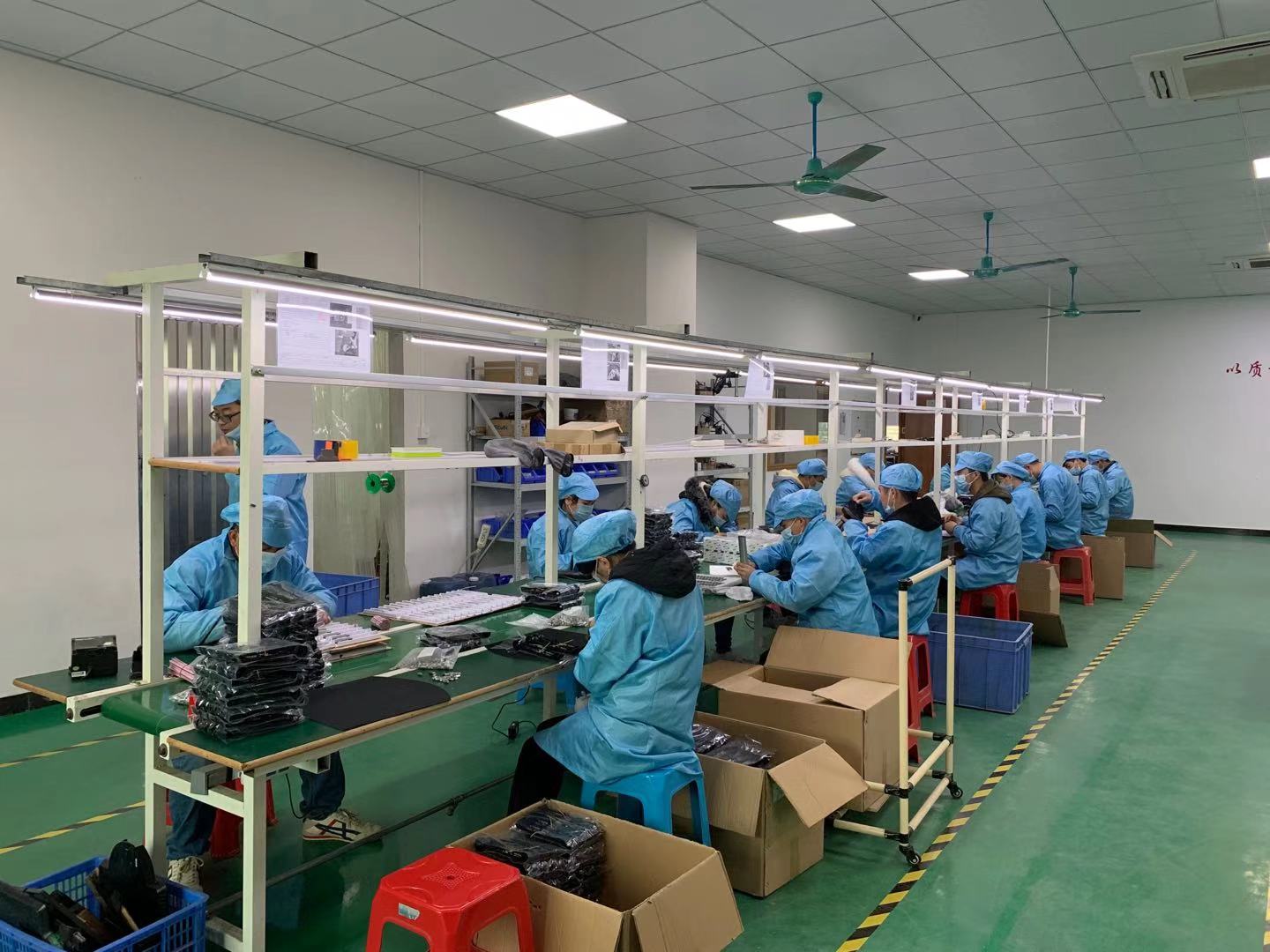
Guangzhou Quibow Electronic Co., Ltd.
Quibow is a technology-driven company working on image data acquisition and conversion. The team develops and supplies photoelectric information equipment — high-speed document cameras, overhead book scanners, flatbed scanners and ID card recognition cameras — across CIS, CMOS and CCD imaging platforms, covering the full cycle from product design and development through production coordination, export sales and after-sales support.
For buyers in Cologne and the wider EU market, that translates into a partner who can answer a technical question about flattening algorithms in the same conversation as a question about FOB terms.
- Business type
- Trading company, onsite checked
- Location
- Guangzhou, Guangdong, China
- Year established
- 2020
- Team
- 5–10 specialists
- Annual revenue
- US$1M – US$2.5M
- Main markets
- E. Europe, N. & S. America
OEM / ODM Ready
Logo printing, packaging, housing colour, capture software branding and SDK integration on selected models.
Low Entry MOQ
Book scanners and A2 large-format models start from one piece or one set; selected document cameras start from two pieces.
Fast, Documented Replies
Average first response within one hour, 100% message response rate and a 27% buyer reorder rate.
Flexible Trade Terms
T/T, L/C, PayPal and Western Union in USD, EUR, HKD or CNY, with FOB, EXW and DDU delivery.
Warranty and Support
One-year warranty on listed models, backed by remote technical support and spare-part dispatch.
Cross-Platform Imaging
Product engineering on CIS, CMOS and CCD platforms, so the recommendation follows the requirement rather than the catalogue.
From First Enquiry to a Cologne Warehouse in Five Steps
Procurement teams want to know what happens after the message is sent. This is the sequence.
Requirement Review
Document size, daily volume, operating system, output format and PDF/A requirement are confirmed, usually within one hour.
Model Matching
We work backwards from the pixel arithmetic to the required dpi, then recommend the sensor platform and resolution.
Sample Validation
Sample scans from a real bound volume, or a single-unit trial order, before any volume commitment.
OEM / ODM Build
Logo, packaging, housing colour, OCR languages, software branding and SDK integration configured to the project.
Shipment to Cologne
Export packing, FOB/EXW/DDU documentation, and routing by air to CGN or by sea via Hamburg or Rotterdam.
Questions Cologne Buyers Ask Before Ordering
The practical questions that come up in almost every enquiry from North Rhine-Westphalia.
How long does delivery to Cologne take from confirmation?
Stock models are dispatched quickly. By air to Cologne/Bonn Airport (CGN), buyers typically see goods within roughly five to nine days of order confirmation, depending on customs clearance. By sea via Hamburg or Rotterdam with onward trucking to Cologne, plan for roughly four to six weeks. Final transit times are confirmed in the quotation.
What do we need to import document scanners into Germany?
You need an EORI number for customs, a correct commodity classification (scanner hardware typically classifies under HS 8471.60), the CE declaration of conformity, and payment of import VAT at the applicable German rate. Quibow supplies the commercial invoice, packing list, CE and RoHS declarations and certificate of origin needed for the declaration.
Does the scanned image leave our network?
With USB and UVC capture models, image data goes directly from the device to the connected workstation and stays there. Software can be installed locally on Windows or macOS machines. If a cloud pathway is required, it is a separate design decision your data protection officer should review — it is not imposed by the hardware.
Is German OCR and PDF/A export supported?
Yes. German OCR is supported alongside English and additional European languages, and output can target searchable PDF as well as PDF/A-2b for long-term archival retention. We recommend testing one page of dense German prose with compound nouns before committing to a volume order.
What is the minimum order quantity, and can we trial first?
Most book scanners, A2 large-format scanners and flatbed scanners start from one piece or one set. Several document camera models start from two pieces. OEM/ODM quantities are confirmed per project. A trial unit or sample scan set is the standard way to validate auto-flatten quality before a larger commitment.
How is warranty handled for a customer in Germany?
Listed models carry a one-year warranty. Fault diagnosis is handled remotely first, and where a hardware replacement is needed, the spare module is dispatched from our side. Consumable and wear items are documented in the manual so maintenance planning is predictable.
Which model suits a 300-page journal volume scanned daily?
For A3 bound material at 300 dpi, an 18MP to 24MP overhead model with auto-flatten and deskew is the practical fit. If the collection includes oversize folios or newspaper runs, step up to an A2 dual-sensor platform so each spread is captured in a single exposure rather than stitched.
Planning a Digitisation or Classroom Rollout in Cologne?
Send your document sizes, daily volume and target resolution. Our engineers will match the sensor platform, confirm the effective dpi for your paper format, and return sample scans from a real bound book before you commit to a purchase order.
Technical enquiries: info@quibowtech.com · Guangzhou Quibow Electronic Co., Ltd.