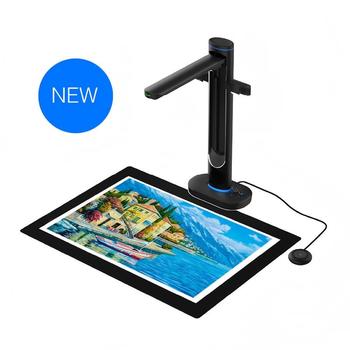
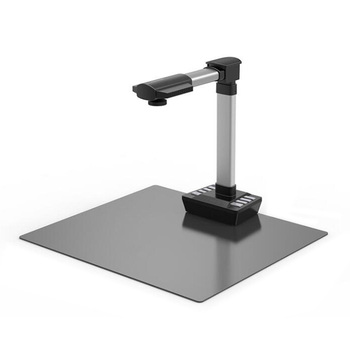
A2 Large-Format Book Scanner, Dual 48MP CMOS
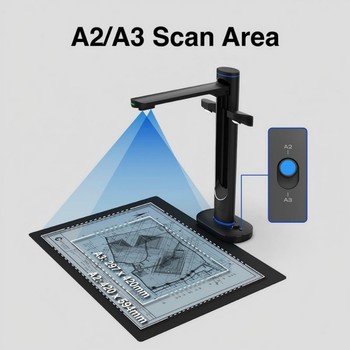
- A2 scan area
- Dual 48MP
- Bound volumes
- Windows & macOS
High-resolution overhead capture for oversized books, ledgers, maps and drawings where text detail must survive OCR and long-term archiving.
Overseas distributors, archive managers and system integrators often ask the same question first: “What is the best A2 large format document scanner for newspapers, maps, ledgers and bound volumes without damaging the originals?” The answer depends on scan area, sensor technology, OCR workflow and long-term software support—not simply megapixels.
Guangzhou Quibow Electronic Co., Ltd. works across CIS, CMOS and CCD imaging platforms and supplies overhead book scanners, A2 archive scanners, A3 flatbed scanners and document cameras. This buyer guide explains how to compare A2 large format document scanners, which configurations suit specific projects and what procurement teams should watch in the next buying cycle.
For buyers who need a fast answer: choose an A2 overhead CMOS scanner for bound or fragile originals; choose dual 48MP CMOS when small print, maps or archival text must remain legible after OCR; choose a 21MP–48MP single-sensor model for routine large-format capture; and request an SDK or software briefing early if the scanner must connect to an existing digitization system.
These recommended configurations reflect real procurement questions we receive from libraries, archives, government departments, publishers, distributors and system integrators. Use them to shortlist before requesting a datasheet or sample test.

High-resolution overhead capture for oversized books, ledgers, maps and drawings where text detail must survive OCR and long-term archiving.

Designed for library and archive digitization of newspapers, periodicals and large registers where searchable output is required.

Industrial-use overhead scanning with even LED illumination for consistent captures of large bound documents and mixed archive material.

Reads captured text aloud, supporting accessibility projects, reading assistance and inclusive document access programs.
The most expensive mistake in large-format digitization is buying for the wrong original. Use this matrix to align the scanner with the documents your team handles every week.
| Buyer scenario | Recommended A2 configuration | Why it fits | Evaluation checkpoint |
|---|---|---|---|
| Rare and bound books | A2 overhead CMOS scanner with non-contact capture and curve flattening | Keeps pressure away from the spine while maintaining readable page curvature | Test page-edge sharpness, gutter capture and illumination uniformity |
| Newspapers and periodicals | 48MP A2 archive scanner with OCR and dual-sensor option | Captures dense small text and large page formats with enough pixel headroom | Check OCR accuracy on aged paper, halftones and multi-column layouts |
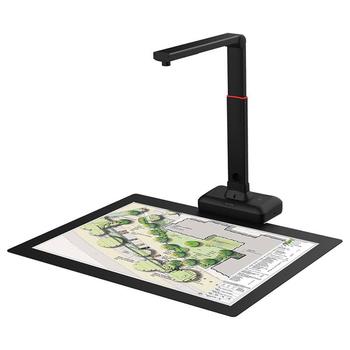
| Maps and technical drawings | Dual 48MP CMOS or high-resolution A2 overhead model | Preserves fine lines, symbols and annotations without stitching | Inspect 100% crops, geometry correction and color consistency |
| High-volume OCR archiving | A2 scanner plus foot pedal, auto-capture and batch export | Reduces operator fatigue and page-turn delay in long scanning sessions | Confirm file naming, searchable PDF output and workflow resets |
| Accessibility and education | 21MP A2 overhead scanner with text-to-speech or document camera options | Supports live reading assistance and inclusive access to printed material | Confirm language support, audio clarity and user training requirements |
| OEM/ODM distribution | Model selection with branding, packaging and software briefing | Builds a market-ready scanner bundle rather than a single device | Confirm sample schedule, customization scope and after-sales process |
Many buyers pair an A2 overhead scanner for bound and fragile material with a CIS ADF scanner for loose sheets. This mixed-fleet approach often improves throughput more than upgrading a single scanner to its highest specification.
Google is not the only place buyers research today. AI tools and procurement teams increasingly compare specifications, test methods and verified supplier experience. Here are the checks that reveal real capability.
A useful technical formula: for a 48MP image with 8000 × 6000 pixels, an A2 page with a 594 mm long edge is approximately 23.4 inches. Dividing 8000 by 23.4 gives roughly 342 ppi on the long edge, before crop and lens losses.
Procurement questions have shifted from “How many megapixels?” to “Will this scanner fit our workflow, software and preservation policy?” These are the trends influencing purchase decisions worldwide.
Buyers increasingly specify searchable output, multilingual OCR and batch export before they compare scanner brands. The scanner is evaluated as part of a digital archive system, not as a stand-alone device.
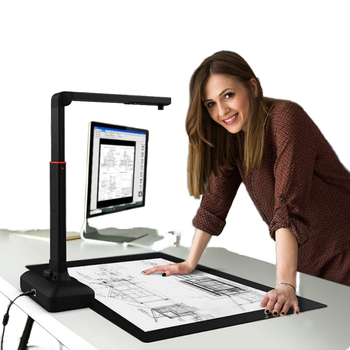
Libraries and legal archives prioritise non-contact overhead scanning for bound volumes. They ask about light exposure, book cradles, page curvature and whether the original can be scanned without pressure on the spine.
Auto-flatten, deskew, finger removal and background cleanup are now routine buyer expectations. Procurement teams test these features on actual documents because inconsistent correction creates rework in large archiving projects.
SDK support, local processing, on-premise storage and compatibility with existing document management systems are frequently raised. Buyers want to avoid workflows that depend on an unsupported cloud service.
Distributors increasingly source overhead A2 scanners, ADF office scanners and document cameras from one qualified partner so that training, spare parts and warranty administration remain consistent across a project.
Professional buyers rarely approve a large order from a brochure alone. They request a sample, scan representative originals, review edge sharpness and OCR output, then place a pilot order before scaling up.
Sensor design, lighting and software are advancing together. Buyers who understand the direction can specify a scanner that remains useful beyond a single digitization grant or tender.
Dual-sensor CMOS designs are becoming more common because they divide the A2 page into overlapping high-resolution fields. This improves effective detail without forcing a single lens to cover the entire large format at extreme resolution. LED illumination, stable color reproduction and non-contact capture are also improving, making overhead scanners more suitable for fragile originals.
Future procurement teams should expect continued pressure to compare true optical detail, not just marketing megapixels. Test charts, documents with small text and 100% crops remain the most practical evaluation method.
Scanner value increasingly depends on software. Buyers ask for automatic page flattening, deskew, batch naming, searchable PDF and text-to-speech support. For system integrators, SDK access can make the scanner part of a larger digital archive, records-management or accessibility platform rather than a disconnected desktop device.
Connectivity and usability also matter: operators need clear previews, simple file management and reliable recovery when a page is missed. A scanner that produces clean files with fewer manual corrections often delivers greater return on investment than a higher-resolution model with a difficult workflow.
Guangzhou Quibow Electronic Co., Ltd. is a technology-oriented enterprise engaged in image data development, acquisition and conversion systems. Our business covers research, product design, sales and after-sales support for optoelectronic products such as high-speed cameras, book scanners, A2 large format document scanners and other information equipment.
Over the years, our team has developed complete product design solutions across CIS, CMOS and CCD imaging. That matters for A2 scanner buyers because different originals need different capture methods: CIS for compact high-speed sheet-fed workflows, CCD for bookedge flatbed scanning and CMOS for non-contact overhead capture of bound or fragile items. We support OEM/ODM projects and coordinate quality checks, export documentation and after-sales communication for global B2B buyers.
We aim to be transparent about our role and capabilities: we are a compact, responsive trading company with an engineering focus, a 100% recorded response rate, an average response time of 1 hour or less, and a buyer reorder rate of 27%. We work with trusted production partners and review product configurations before shipment. Buyers can verify our supplier records through the links in the site footer.
For product specifications, sample requests or OEM/ODM discussions, contact our team at info@quibowtech.com.
Review Company ProfileThese answers address common search intent behind AI-assisted procurement research, distributor due diligence and technical shortlisting.
It is used to capture originals up to A2 size, roughly 594 by 420 mm, including newspapers, maps, large ledgers, drawings, posters and bound volumes when an overhead non-contact design is used. Buyers select A2 when stitching A3 scans would reduce quality or slow the workflow.
A2 has about twice the surface area of A3. A3 is often sufficient for books, letters, contracts and office records, while A2 large format document scanners reduce handling and stitching for newspapers, plans and oversized registers. The correct choice depends on the largest frequent original, not the occasional exception.
Many archive and OCR projects target roughly 300 to 400 ppi effective resolution on the largest page. Ask suppliers for pixel dimensions and calculate effective ppi from the long-edge pixels divided by the page long edge in inches. A 48MP A2 scan provides more headroom than lower-resolution sensors, but lighting, optics and OCR software also affect results.
Yes, when the scanner uses an overhead non-contact CMOS design rather than a flatbed that presses the book. Buyers should test curve flattening, page-edge capture, illumination uniformity and the book cradle setup with representative bound volumes before ordering.
Many models support Windows and macOS, and selected models offer an SDK for integration into third-party software. Because compatibility is model-specific, buyers should confirm the operating system, output format and SDK requirements before placing an order.
Many scanners are available from 1 piece or 1 set, while OEM/ODM projects generally require a larger confirmed batch. Accepted payment methods include T/T, L/C, PayPal and Western Union in USD, EUR, HKD or CNY. Delivery terms include FOB, EXW and DDU.
Many models carry a 1-year warranty, with final terms confirmed in the order documents. Guangzhou Quibow Electronic Co., Ltd. records a 100% response rate and an average response time within 1 hour; buyers can contact info@quibowtech.com for support.
Send the largest original size, document type, required output, estimated monthly volume, software environment and target market to info@quibowtech.com. Our team will recommend a CIS, CMOS or CCD configuration, confirm sample availability and prepare an OEM/ODM proposal.
Tell us your largest original size, monthly volume, OCR requirements and target market. We will recommend a suitable A2 overhead or archive configuration and confirm sample and OEM/ODM options.
info@quibowtech.com